
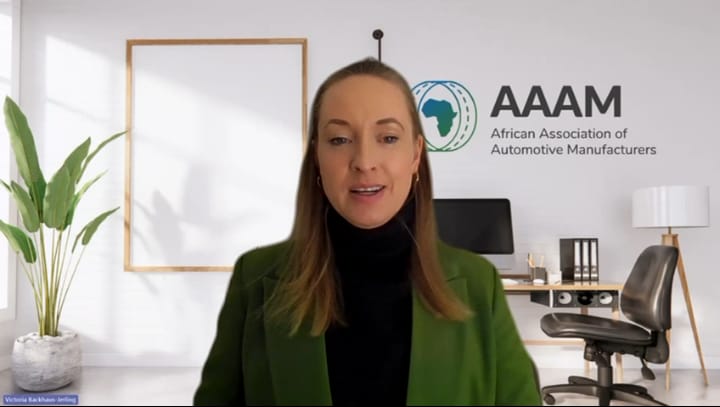
AAAM Tasks Nigeria on Legislation of Automotive Policy
The African Association of Automotive Manufacturers (AAAM) has stressed the need for Nigeria to legalise its automotive policy to provide the foundation for sustainable local manufacturing, job creation and boost investors’ confidence.
Chief Executive Officer, AAAM, Victoria Backhaus-Jerling, stated this yesterday in Lagos at the second Nigeria Auto Industry Summit organised by Nigeria Auto Journalists Association (NAJA) in collaboration with the National Automotive Design and Development Council (NADDC).
The summit brought together key industry figures, including the Minister of State for Industry, Trade and Investment, Senator John Owan Enoh; Director-General of the National Automotive Design and Development Council (NADDC), Joseph Oluwemimo Osanipin; Comptroller-General of the Nigeria Customs Service, Adewale Bashir; Director-General of the Standards Organisation of Nigeria (SON), Ifeanyi Chukwunonso Okeke; the leadership of the Nigerian Automobile Manufacturers Association (NAMA), and international dignitaries.
In her remarks, the AAAM CEO highlighted Africa as “the world’s last automotive frontier” with Nigeria poised to be a continental leader, citing the country’s population, human capital, and entrepreneurial energy as key advantages.
However, she stressed that Nigeria’s success hinges on the establishment and enforcement of an enabling regulatory framework.
“With its scale, talent and entrepreneurial spirit, Nigeria has all the right ingredients to lead,” she said. “What’s needed now is policy certainty to match that potential.”
According to Backhaus-Jerling, AAAM works across the continent with governments and private partners to support policy development, attract investments, and build regional value chains within the African Continental Free Trade Area (AfCFTA).

She maintained that every African country, including Nigeria, can play a role in a continental automotive value chain — whether in vehicle assembly, component manufacturing, or mineral processing.
She noted that although Nigeria’s journey toward industrialisation had begun, progress could stall in the absence of a clear and consistent policy direction. She warned of the dangers posed by unchecked imports of used vehicles, which continue to undermine local manufacturing efforts.
“The right regulatory framework will provide the foundation for sustainable local manufacturing, job creation and investor confidence. Without it, the sector remains vulnerable,” she added.
While recognising the strides made by countries like Morocco, Egypt, Ghana, and South Africa, Backhaus-Jerling emphasised that Nigeria could surpass them if the political will is matched with action.
She concluded with a call for bold thinking and strategic planning during the summit, encouraging participants to envision what Nigeria’s automotive landscape should look like in the next decade — and what steps must be taken today to make that vision a reality.
“Let’s keep driving Africa forward, together,” she urged.
Copyright ©The Daily Bells.
All rights reserved. This material, and other digital content on this website, may not be reproduced, published, broadcast, rewritten or redistributed in whole or in part without prior express written permission from The DAILY BELLS.
HELLO! Do you have any NEWS you will like to share with The Daily Bells?
Contact us today for your Press Releases, Opinions, Others.
SMS: +2348060176677, WhatsApp: +2348025237926, Email: mydailybells@gmail.com

